

ESG Snapshot: Issue 150

1ESG Snapshot is delivered by the Business Council for Sustainable Development Australia to 900+ sustainability & ESG professionals every week.
We analyse hundreds of articles, data, insights and resources from the most reliable international and national sources, filter & distil their importance, to deliver them to you in bite-sized intelligence.
Choose the level of access that best supports your work
VISITOR ACCESS | SEE THE WEEK
Get a public preview of the week’s principal sustainability and ESG developments, together with selected BCSDA notices and Featured Events involving BCSDA, our Members and Partners.
In this issue: Review the Three Key Takeaways, selected developments and Featured Events.
SUBSCRIBER ACCESS | BROADEN YOUR VIEW
Register free to access a wider range of practical sustainability opportunities and resources, including Upcoming Events, Grants, Jobs, Resources and What We Are Tracking for the week ahead.
In this issue: Explore current opportunities, upcoming deadlines and practical resources relevant to business.
Register Free for Subscriber Access
BCSDA MEMBER ACCESS | UNDERSTAND AND ACT
BCSDA Membership is for organisations that need to do more than stay informed.
Members receive the complete intelligence behind ESG Snapshot, with deeper analysis across BCSDA’s six Focus Areas, primary-source evidence, business implications and practical next steps.
Use the Focus Areas to understand what developments mean for your organisation. Use Consult Watch to identify policy consultations early and decide where your evidence or experience could help shape the outcome. Use the new Membership Criteria Self-Assessment to see where your organisation is performing strongly, where evidence may be incomplete and where further implementation work may be needed.
The benefit is practical: less time scanning, earlier visibility of material change, stronger evidence for internal decisions, and a clearer path from intelligence to action.
Members can also promote eligible organisational vacancies through the ESG Snapshot Jobs Board and connect BCSDA intelligence with relevant briefings, engagement and implementation activity.
Not sure whether your organisation is already a BCSDA Member — or want to understand what Membership could provide your team? Email bcsda@bcsda.org.au.
Three Key Takeaways
- The test is shifting from ambition to evidence. Regulators, investors and standards are increasingly asking whether sustainability claims survive controls, data and delivery.
- Capital is moving toward implementation. Grids, batteries, transport, adaptation and critical minerals are increasingly being judged on bankability, execution and resilience.
- Nature and circularity are becoming operational. Ocean governance, nature-risk guidance, product stewardship and closed-loop materials are turning commitments into rules, systems and measurable outcomes.
More detail for Members in The Week That Was
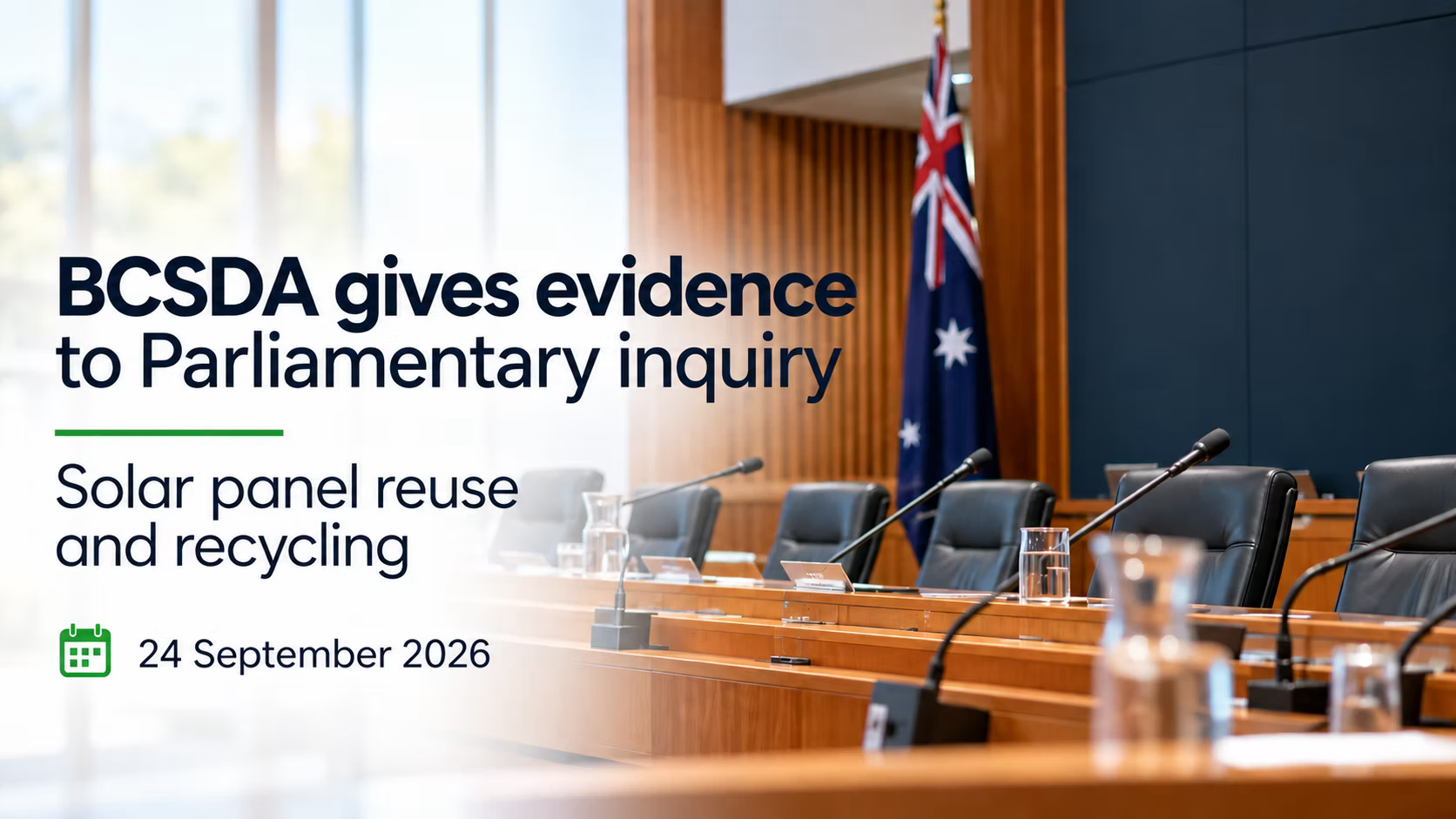
BCSDA appeared before the House of Representatives inquiry into solar panel reuse and recycling this week, following our lodgement of Submission 22.
Our evidence addresses product stewardship, collection and logistics, reuse pathways, domestic recycling and end-markets, data and traceability, and the sequencing of policy measures needed to improve circular outcomes for Australia’s growing stock of solar panels.
BCSDA lodged its submission on 25 September 2026 in response to the Australian Government’s consultation on strengthening Australia’s modern slavery framework.
The submission brings together BCSDA’s position on practical implementation of reform, including the proposed failure-to-prevent model, due diligence, accountability, supply-chain implementation and the need for settings that support effective action by business.
BCSDA’s submission focuses on how reform can strengthen Australia’s response to modern slavery while providing businesses with clearer expectations and workable implementation pathways.
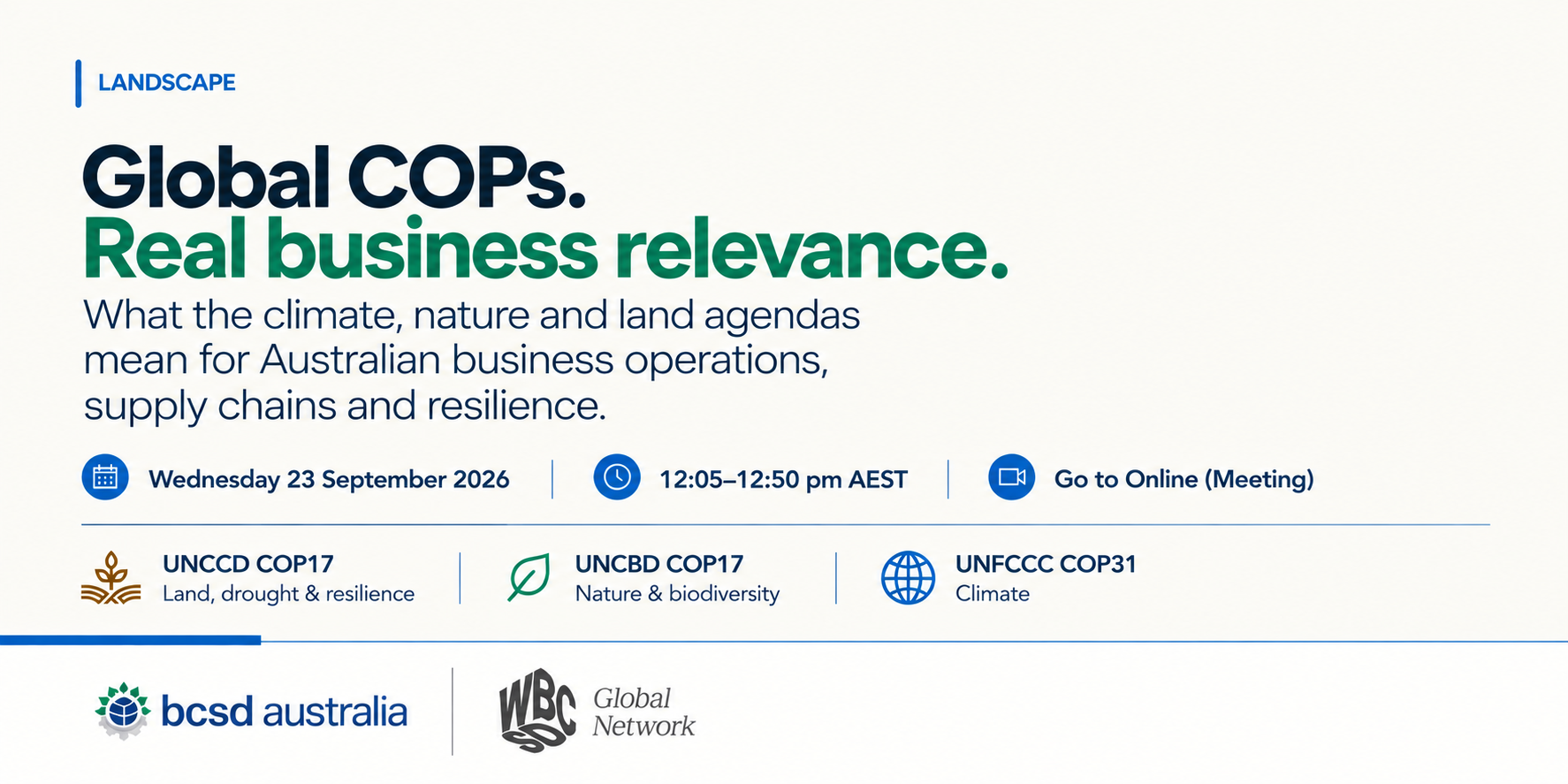
Climate, biodiversity and land degradation are governed through three separate Rio Conventions.
But the business implications are increasingly meeting in the same place.
That was the central signal from this week’s BCSDA LANDSCAPE, with Fleur Downard, Melissa Cotterill and Ilona Millar examining developments across UNCCD COP17, the upcoming CBD COP17 and COP31.
Three things to watch:
- LAND — UNCCD is moving business further into implementation through land restoration, drought resilience, sustainable land management and private finance.
- NATURE — CBD COP17 will conduct the first global review of progress under the Kunming-Montreal Global Biodiversity Framework, with business-facing Targets 14, 15 and 16 firmly in view.
- CLIMATE — COP31 is increasingly about implementation: finance, adaptation, just transition, NDC delivery and the relationship between negotiations and the real-economy Action Agenda.
But the bigger story is the connection between them. Finance, supply chains, governance and investment increasingly need to consider climate + nature + land together — and look for implementation that generates benefits across all three.

This week, Treasury’s climate-related financial disclosure roundtable and thinkstep-anz’s Beyond Reporting: What Really Matters both take place online on 29 September. From 30 September–2 October, Sydney hosts the Asia Pacific Circular Economy Hotspot 2026, convened by Circular Australia with BCSDA involvement.
Looking ahead, BCSDA’s next EXCHANGE is on 12 October, followed by the CBD COP17 government–business biodiversity session in Yerevan on 23 October. On 28 October, BCSDA’s LANDSCAPE will focus on the business relevance of issues heading into UNFCCC COP31 in Antalya.