

ESG Snapshot: Issue 149

ESG Snapshot is delivered by the Business Council for Sustainable Development Australia to 900+ sustainability & ESG professionals every week.
We analyse hundreds of articles, data, insights and resources from the most reliable international and national sources, filter & distil their importance, to deliver them to you in bite-sized intelligence.
Choose the level of access that best supports your work
VISITOR ACCESS | SEE THE WEEK
Get a public preview of the week’s principal sustainability and ESG developments, together with selected BCSDA notices and Featured Events involving BCSDA, our Members and Partners.
In this issue: Review the Three Key Takeaways, selected developments and Featured Events.
SUBSCRIBER ACCESS | BROADEN YOUR VIEW
Register free to access a wider range of practical sustainability opportunities and resources, including Upcoming Events, Grants, Jobs, Resources and What We Are Tracking for the week ahead.
In this issue: Explore current opportunities, upcoming deadlines and practical resources relevant to business.
Register Free for Subscriber Access
BCSDA MEMBER ACCESS | UNDERSTAND AND ACT
BCSDA Membership is for organisations that need to do more than stay informed.
Members receive the complete intelligence behind ESG Snapshot, with deeper analysis across BCSDA’s six Focus Areas, primary-source evidence, business implications and practical next steps.
Use the Focus Areas to understand what developments mean for your organisation. Use Consult Watch to identify policy consultations early and decide where your evidence or experience could help shape the outcome. Use the new Membership Criteria Self-Assessment to see where your organisation is performing strongly, where evidence may be incomplete and where further implementation work may be needed.
The benefit is practical: less time scanning, earlier visibility of material change, stronger evidence for internal decisions, and a clearer path from intelligence to action.
Members can also promote eligible organisational vacancies through the ESG Snapshot Jobs Board and connect BCSDA intelligence with relevant briefings, engagement and implementation activity.
Not sure whether your organisation is already a BCSDA Member — or want to understand what Membership could provide your team? Email bcsda@bcsda.org.au.
Three Key Takeaways
1. Australia is moving several sustainability issues from policy direction into implementation rules. Data-centre standards, NEM reform, packaging harmonisation, ERA governance and NSW forestry approvals all moved into more concrete regulatory or operating processes this week.
2. The energy transition is showing up in operating assets, not just commitments. NSW brought 980 MW of batteries and 95 MW of flexible demand into operation; Hysata moved toward commercial-scale electrolyser manufacturing; Sydney Airport expanded electric buses; and Incat delivered its electric ferry to South America.
3. Companies are being pushed toward more specific evidence of performance. Rio Tinto set measurable site-level nature targets; Verra launched a Scope 3 verification framework; NVIDIA highlighted a use-phase accounting question; and Fair Work’s A$453 million wage recovery reinforced the importance of enterprise-level control evidence.
More detail for Members in The Week That Was
BCSDA has submitted to the Australian Government’s Horizon Europe implementation consultation, focusing on the practical architecture needed to help Australian businesses, universities and research organisations participate effectively from 2027. The submission recommends clear national triage, thematic specialist capability, active consortium brokerage, targeted support where participation friction is evidenced, and success measures that go beyond funding won. Australia concluded Horizon Europe treaty negotiations with the European Commission on 9 June 2026 and is completing its domestic treaty process; Australian entities are expected to be able to apply for Pillar II opportunities from 1 January 2027 under transitional arrangements.
BCSDA will now track: treaty progress, National Contact Point and applicant-support arrangements, and practical guidance for 2027 participation.
BCSD Australia has lodged its submission to the Australian Government’s 2026–27 Safeguard Mechanism Review.
Our central proposition is to calibrate the mechanism rather than rebuild it, with post-2030 settings that give business clearer signals for industrial decarbonisation and investment.
The submission focuses on five areas: measuring real emissions and investment outcomes; flexibility mechanisms; the post-2030 trajectory; carbon leakage and competitiveness; and reducing implementation friction.
For business: the next question is how future Safeguard settings translate emissions obligations into credible physical abatement, investment decisions and workable implementation.
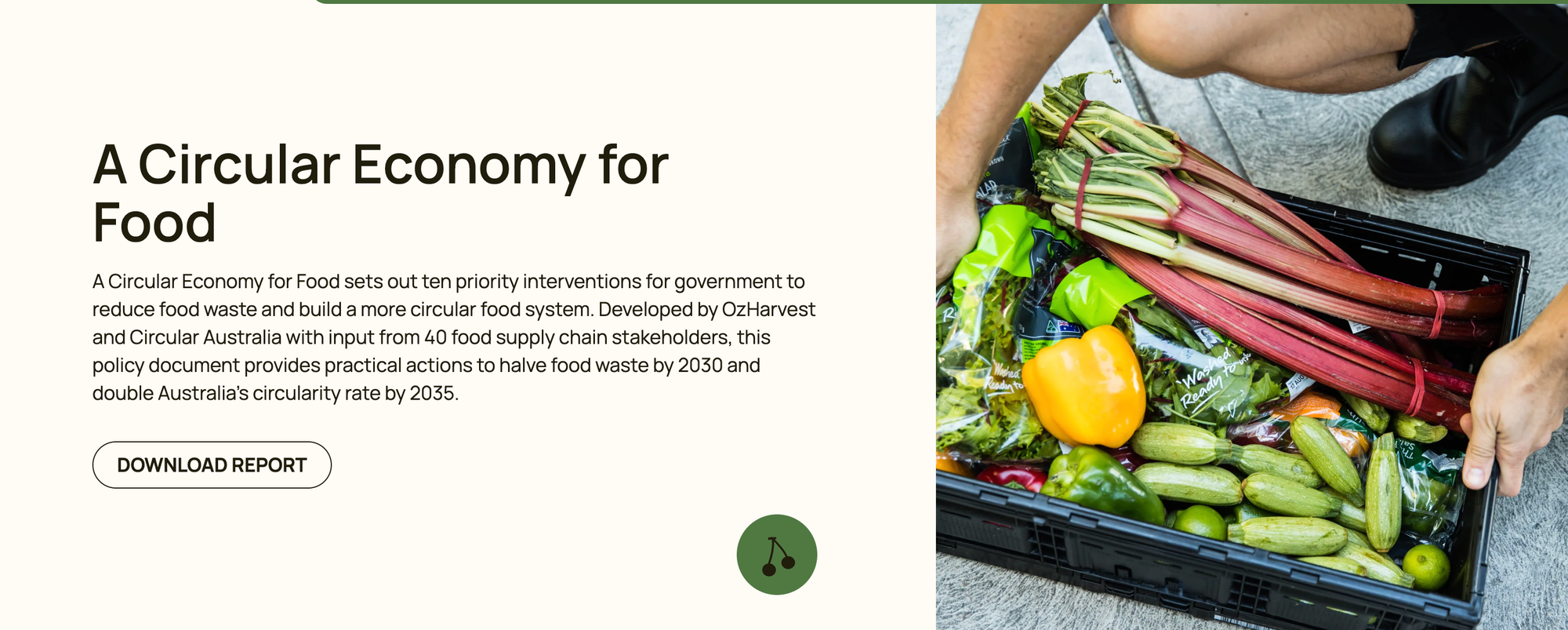
Circular Australia and OzHarvest launched A Circular Economy for Food: Priority Government Interventions to Reduce Food Waste at Parliament House on 17 September, following consultation with 40 stakeholders across the food supply chain.
BCSD Australia was one of the stakeholders consulted in developing the report, and CEO Andrew Petersen attended the Parliament House launch. Our contribution focused particularly on the practical implementation of the proposed interventions — including food date labelling, potential ACCU Scheme pathways, Commonwealth and state responsibilities, and nationally consistent data and reporting.
The resulting report proposes 10 Federal Government interventions spanning food-waste prevention, redistribution of edible surplus, circular markets and infrastructure, source separation, data and accountability.
For business, the important question is what comes next: how can companies prevent avoidable waste, redirect edible surplus, recover greater value from remaining materials and provide useful data without creating duplicative reporting systems?
BCSD Australia’s involvement also draws on our connection to the World Business Council for Sustainable Development and its substantial international work across food systems and the circular economy.
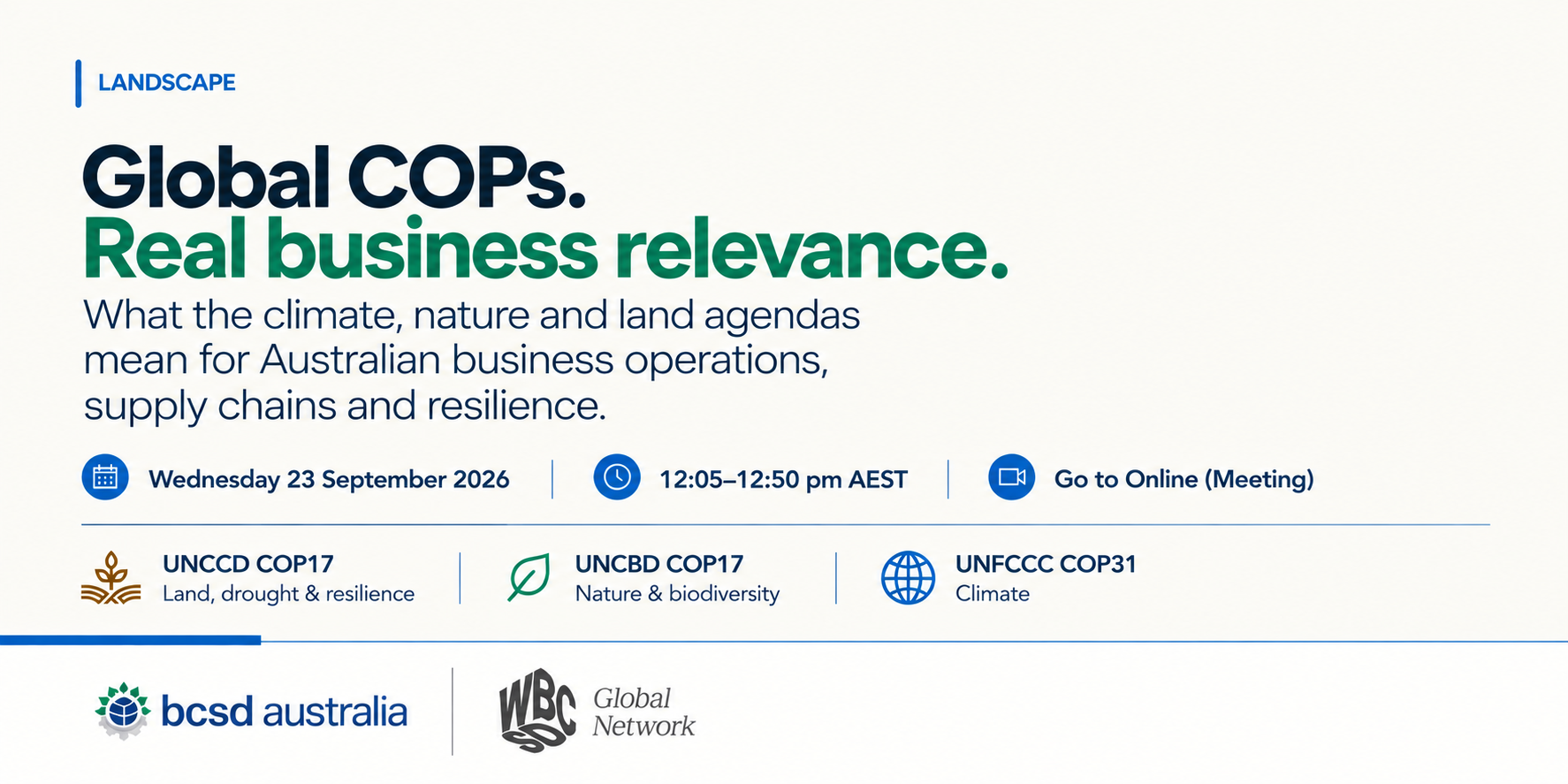
Three major global sustainability processes are moving towards their next COPs: climate (UNFCCC COP31), nature and biodiversity (UNCBD COP17), and land, drought and resilience (UNCCD COP17). But what do negotiations in these global forums actually mean for Australian organisations?
For Australian business, these agendas increasingly connect to practical questions about operations, supply chains, access to natural resources, physical risk and resilience, nature dependencies, disclosure and investment. Decisions made internationally can influence the policy settings, market expectations and implementation priorities that ultimately reach Australian businesses and their value chains.
Join BCSD Australia LANDSCAPE for a practical discussion bringing together three perspectives from across these agendas:
Fleur Downard, Department of Climate Change Energy Environment and Water, will examine the UNCCD agenda and what land degradation, drought, restoration and resilience mean for Australian organisations and supply chains.
Melissa Cotterill, Department of Climate Change Energy Environment and Water, will look ahead to UNCBD COP17, exploring the evolving global biodiversity agenda and the implications for Australian business as expectations around nature move increasingly towards implementation.
Ilona Millar, Gilbert & Tobin will bring the UNFCCC/COP31 perspective, examining where the climate negotiations are heading and what the emerging agenda means for Australian businesses preparing for the next phase of the transition.
Rather than treating climate, nature and land as three separate conversations, LANDSCAPE will ask where they are converging — and what Australian organisations should be watching, preparing for and acting on now.

The next fortnight brings several high-value opportunities to connect intelligence with action. LANDSCAPE on 23 September brings COP31, UNCBD COP17 and UNCCD COP17 together for Australian business. Treasury’s climate-related financial disclosure roundtables continue on 22 and 29 September, while thinkstep-anz’s Beyond Reporting on 29 September will feature BCSDA CEO Andrew Petersen. From 30 September, the Asia Pacific Circular Economy Hotspot brings regional leaders to Sydney to explore circular markets, critical minerals, decarbonisation and nature.