

ESG Snapshot: Issue 148

ESG Snapshot is delivered by the Business Council for Sustainable Development Australia to 900+ sustainability & ESG professionals every week.
We analyse hundreds of articles, data, insights and resources from the most reliable international and national sources, filter & distil their importance, to deliver them to you in bite-sized intelligence.
Choose the level of access that best supports your work.
VISITOR ACCESS | PREVIEW THE WEEK
Get a public preview of the week’s principal sustainability and ESG developments, selected BCSDA notices and Featured Events involving BCSDA, our Members and Partners.
In this issue: Review the Three Key Takeaways, selected news and Featured Events.
SUBSCRIBER ACCESS | BROADEN YOUR VIEW
Register free to access an expanded weekly selection of sustainability opportunities and practical resources, including Upcoming Events, Grants, Jobs, Podcasts, What we are Tracking for the week & important closing dates.
In this issue: Explore newly added events, current grant opportunities, sustainability vacancies and selected podcasts and resources.
Register Free for Subscriber Access
BCSDA MEMBER ACCESS | UNDERSTAND WHAT IT MEANS FOR BUSINESS
Personnel from BCSDA Member organisations receive the complete edition: The Week That Was, national and international coverage, state and territory developments, company and finance news, UN convention trackers, all 17 SDG analyses, primary-source links and practical implications for Australian business.
Members can also promote eligible organisational vacancies through the ESG Snapshot Jobs Board.
In this issue: Access the complete analysis, evidence and business implications behind the week’s developments.
Not sure whether your organisation is a BCSDA Member? Contact bcsda@bcsda.org.au to confirm your access.
Three Key Takeaways
1. Compliance moved closer to implementation I Australia endorsed a national technical framework for consumer energy equipment; the UK moved CBAM into verified product-emissions requirements; South Africa tested an ISSB-aligned reporting pathway with preparers; and NSW opened consultation on an updated Biodiversity Assessment Method.
2. Delivery systems mattered as much as the technology I NVIDIA and Australian partners outlined an up-to-2 GW AI infrastructure build-out; Yara’s cross-border CCS project moved into physical operation; New Zealand locked in a producer-funded farm-plastics scheme with fees, quarterly data and tracked take-back; and EV growth continued to expose gaps in workshop capability, charging and vehicle availability.
3. Sustainability risks showed up in finance, operations and workforce controls I The Hormuz shock fed through to an ECB rate rise; chronic climate risk raised asset-value questions; WMO linked wildfire smoke and heat to workforce-health and continuity risk; BHP faced a public-holiday class action; and industrial disputes remained elevated year-on-year in Australia.
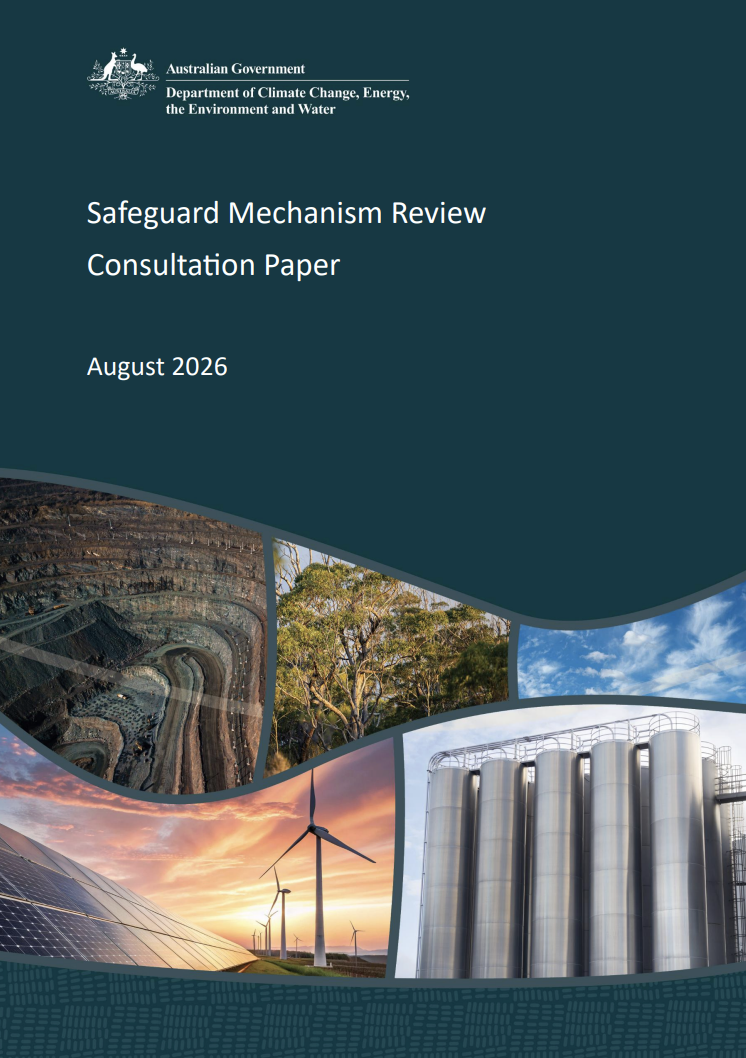
Australia’s Safeguard Mechanism is being reviewed for the period beyond 2030, with major questions open around baseline decline rates, onsite abatement, carbon-credit flexibility, scheme coverage and trade exposure.
BCSD Australia is gathering practical business evidence to inform our response.
We are interested in what these settings mean in practice for investment decisions, facility abatement, ACCU and SMC strategy, the 100,000 t CO₂-e coverage threshold, facility boundaries, competitiveness and carbon leakage.
You can respond only to the questions relevant to your organisation, and choose how BCSDA may attribute your evidence.
This is a BCSDA evidence pulse, not the Australian Government submission portal. Results will be during BCSDA LANDSCAPE on 23 September 2026. DCCEEW’s formal consultation closes at 11:59pm AEST on 18 September 2026.
The Australian Government has announced that Climate Active certification will end. The question now is what should remain after certification closes — including whether selected voluntary emissions standards and guidance should be retained.
BCSD Australia is gathering practical business evidence to inform our response.
We want to understand where Climate Active certification, standards, trade marks or claims are currently relied upon; what problems full closure could create; which standards, methods or tools businesses still find useful; how any successor guidance should interact with mandatory climate reporting; and what transition and claims safeguards are needed.
You do not need to answer every question. One practical example, correction or recommendation is useful.
Responses can be named, organisation-only, de-identified or used only in aggregate.
This is a BCSDA evidence process, not the Australian Government submission portal. Results will be during BCSDA LANDSCAPE on 23 September 2026. DCCEEW’s formal consultation closes at 5:00pm AEST on 18 September 2026.

Australia’s new National Environmental Protection Agency is asking stakeholders to help shape how it administers and regulates national environmental protection laws.
Its inaugural stakeholder survey is seeking feedback on practical regulatory experience — including communication, guidance and resources, transparency and integrity of decisions, and regulatory timeframes.
BCSD Australia is providing an additional business-feedback route for organisations that would prefer to share evidence through BCSDA for synthesis, de-identification or aggregation.
We are particularly interested in businesses that have interacted with a National EPA regulatory function. We want to understand what is working and where practical improvements are needed — including communication, guidance, portals, regulatory timeframes, decision notices and approval conditions, and whether businesses can readily determine which EPBC implementation stage applies to a project.
Respond directly to the National EPA through its official stakeholder survey: National EPA official stakeholder survey
Responses through BCSDA can be named, organisation-only, de-identified or used only in aggregate. Results will be shared during BCSDA LANDSCAPE on 28 October 2026.
Important: providing evidence to BCSDA does not itself submit a response to the National EPA. If you want your feedback considered directly in the official survey, use the National EPA consultation platform.

Our September BCSDA EXCHANGE brings member perspectives into the conversation.
Kathryn Wightman-Beaven from Bolton Clarke joins us for our Member Spotlight, sharing some of the sustainability priorities Bolton Clarke is working through and what it hopes to contribute to — and learn from — the BCSDA community.
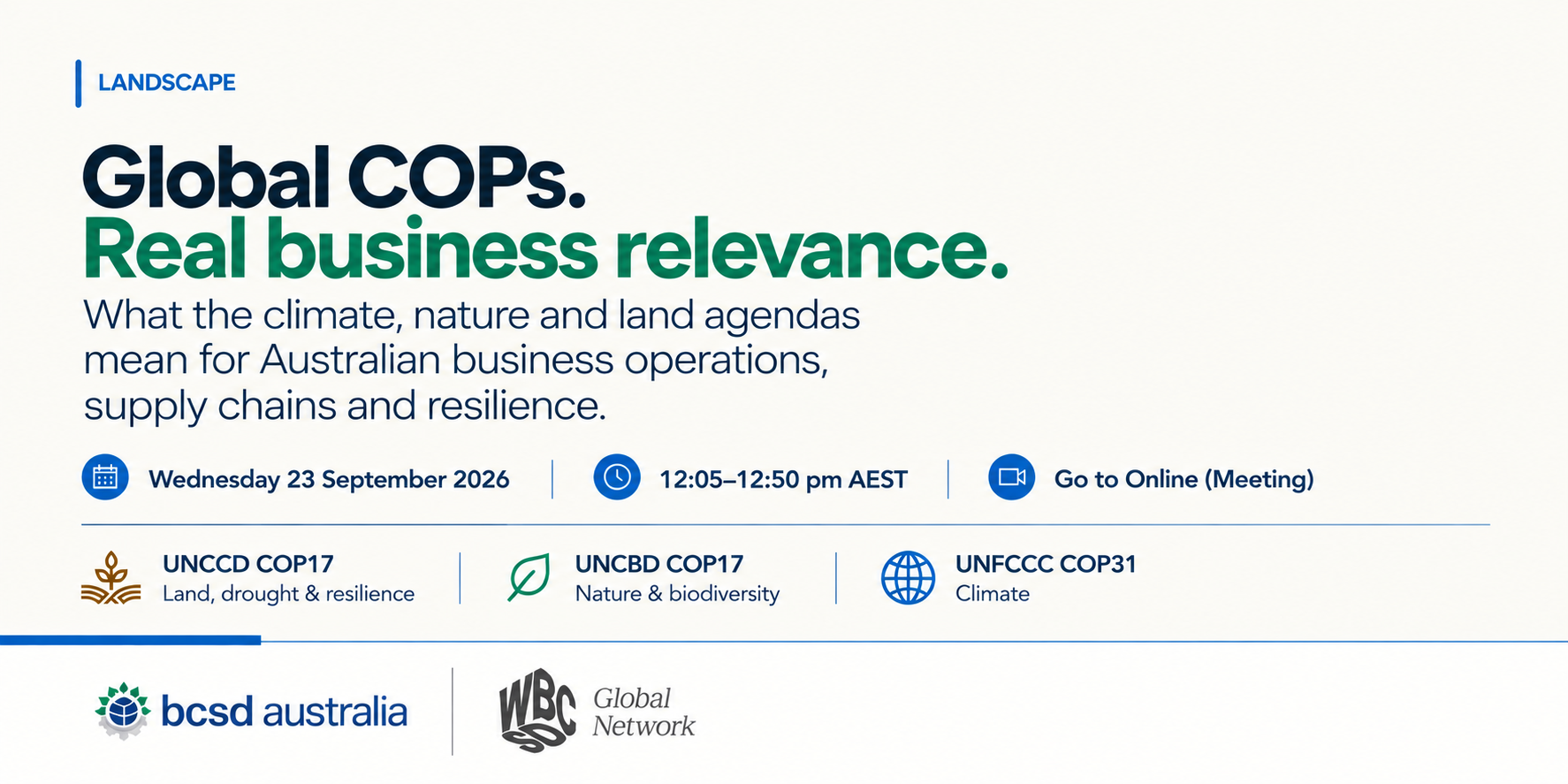
Three major global sustainability processes are moving towards their next COPs: climate (UNFCCC COP31), nature and biodiversity (UNCBD COP17), and land, drought and resilience (UNCCD COP17). But what do negotiations in these global forums actually mean for Australian organisations?
For Australian business, these agendas increasingly connect to practical questions about operations, supply chains, access to natural resources, physical risk and resilience, nature dependencies, disclosure and investment. Decisions made internationally can influence the policy settings, market expectations and implementation priorities that ultimately reach Australian businesses and their value chains.
Join BCSD Australia LANDSCAPE for a practical discussion bringing together three perspectives from across these agendas:
Fleur Downard, Department of Climate Change Energy Environment and Water, will examine the UNCCD agenda and what land degradation, drought, restoration and resilience mean for Australian organisations and supply chains.
Melissa Cotterill, Department of Climate Change Energy Environment and Water, will look ahead to UNCBD COP17, exploring the evolving global biodiversity agenda and the implications for Australian business as expectations around nature move increasingly towards implementation.
Ilona Millar, Gilbert & Tobin will bring the UNFCCC/COP31 perspective, examining where the climate negotiations are heading and what the emerging agenda means for Australian businesses preparing for the next phase of the transition.
Rather than treating climate, nature and land as three separate conversations, LANDSCAPE will ask where they are converging — and what Australian organisations should be watching, preparing for and acting on now.

The Featured calendar is packed with practical sessions for the weeks ahead. BCSDA EXCHANGE returns on 14 September, followed by Business for Nature’s Final Countdown to COP17 and a free briefing on the EU’s Packaging and Packaging Waste Regulation on 15 September. Treasury’s climate-related financial disclosure roundtables then tackle Scope 3 and supply chains, investor expectations, reporting capability, assurance and AI-enabled data collection, while thinkstep-anz goes behind the scenes of Moose Toys’ sustainability journey and later asks what really matters beyond reporting.
BCSDA’s LANDSCAPE series turns to COP31 and its business implications, while October brings further EXCHANGE sessions and SBCNZ’s practical modern slavery workshop series.