

ESG Snapshot: Issue 147

ESG Snapshot is delivered by the Business Council for Sustainable Development Australia trusted by 870+ sustainability & ESG professionals.
We analyse hundreds of articles, data, insights and resources from the most reliable international and national sources, filter & distil their importance, to deliver them to you in bite-sized chunks every week.
Choose the level of access that best supports your work.
VISITOR ACCESS | PREVIEW THE WEEK
Get a public preview of the week’s principal sustainability and ESG developments, selected BCSDA notices and Featured Events involving BCSDA, our Members and Partners.
In this issue: Review the Three Key Takeaways, selected news and Featured Events.
SUBSCRIBER ACCESS | BROADEN YOUR VIEW
Register free to access an expanded weekly selection of sustainability opportunities and practical resources, including Upcoming Events, Grants, Jobs, Podcasts, What we are Tracking for the week & important closing dates.
In this issue: Explore newly added events, current grant opportunities, sustainability vacancies and selected podcasts and resources.
Register Free for Subscriber Access
BCSDA MEMBER ACCESS | UNDERSTAND WHAT IT MEANS FOR BUSINESS
Personnel from BCSDA Member organisations receive the complete edition: The Week That Was, national and international coverage, state and territory developments, company and finance news, UN convention trackers, all 17 SDG analyses, primary-source links and practical implications for Australian business.
Members can also promote eligible organisational vacancies through the ESG Snapshot Jobs Board.
In this issue: Access the complete analysis, evidence and business implications behind the week’s developments.
Not sure whether your organisation is a BCSDA Member? Contact bcsda@bcsda.org.au to confirm your access.
Three Key Takeaways
- Australia’s transition is running into its next set of constraints: storage, grids, firming and carbon-market integrity.
The week’s Australian stories are not mainly about adding more renewable generation. They are about 100 community batteries, South Australia hitting 2 MW operational demand, WA transmission construction, the A$105.6m ultra-low-cost solar portfolio, EVs becoming the largest monthly powertrain category, and the ACCU/Safeguard integrity and Beetaloo threshold debates. The transition is moving from “build renewables” to how the system actually works at scale. - Physical climate risk is showing up directly in infrastructure, water and balance sheets.
Nepal lost 431 MW of operating generation to flooding; the Amazon drought analysis found 38% of inhabited localities highly exposed; the UK recorded its provisionally hottest summer; Victoria extended drought-resilience funding; NSW opened a data-centre water-pricing review; and catastrophe-loss modelling, Robeco’s resilience scoring and first-wave AASB S2 reporting all point in the same direction. Adaptation is becoming an investment and operating-cost issue, not just a climate-risk disclosure. - Nature and sustainability rules are increasingly being converted into actual financial and commercial mechanisms.
This week included the EU Nature Restoration Law moving into national plans, the UK creating a developer-levy pathway for nature restoration, Atom Bank financing habitat-bank creation, the UK putting £400m behind the Tropical Forest Forever Facility, Viresco launching a A$500m farmland fund with natural-capital revenue potential, Japan issuing nature-finance guidance, and the Cali Fund still struggling to mobilise money. The signal is mixed but concrete: nature is moving into lending, investment, development approvals and public finance — but the financing architecture is still immature.
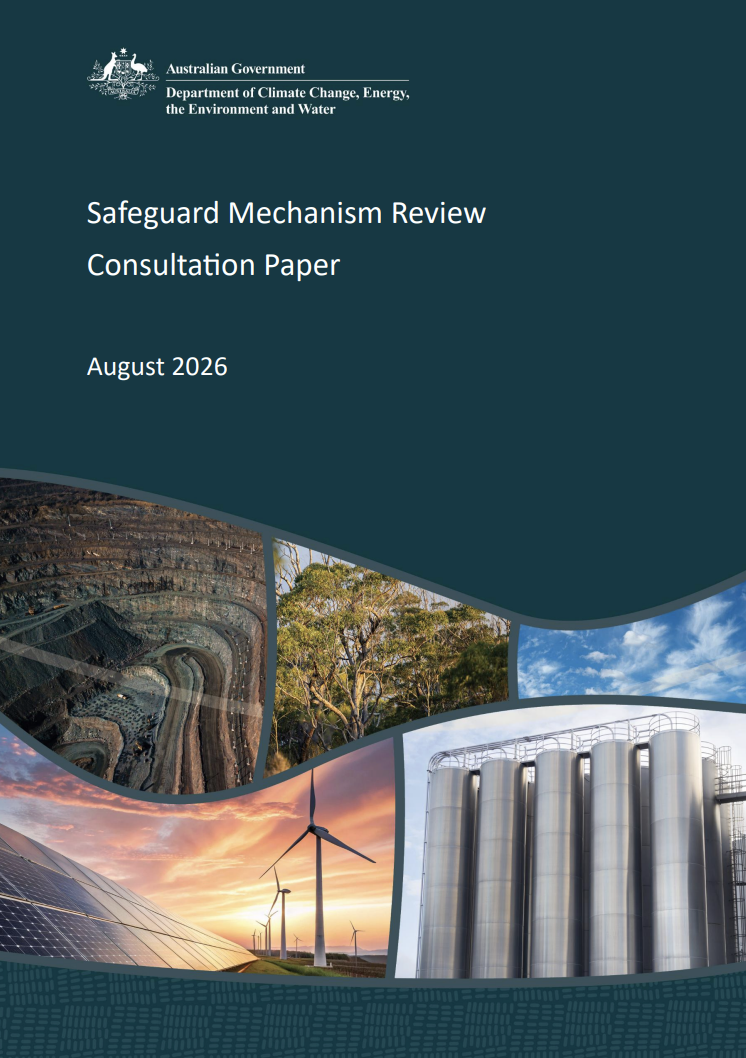
Australia’s Safeguard Mechanism is being reviewed for the period beyond 2030, with major questions open around baseline decline rates, onsite abatement, carbon-credit flexibility, scheme coverage and trade exposure.
BCSD Australia is gathering practical business evidence to inform our response.
We are interested in what these settings mean in practice for investment decisions, facility abatement, ACCU and SMC strategy, the 100,000 t CO₂-e coverage threshold, facility boundaries, competitiveness and carbon leakage.
You can respond only to the questions relevant to your organisation, and choose how BCSDA may attribute your evidence.
This is a BCSDA evidence pulse, not the Australian Government submission portal. Results will be during BCSDA LANDSCAPE on 23 September 2026. DCCEEW’s formal consultation closes at 11:59pm AEST on 18 September 2026.
The Australian Government has announced that Climate Active certification will end. The question now is what should remain after certification closes — including whether selected voluntary emissions standards and guidance should be retained.
BCSD Australia is gathering practical business evidence to inform our response.
We want to understand where Climate Active certification, standards, trade marks or claims are currently relied upon; what problems full closure could create; which standards, methods or tools businesses still find useful; how any successor guidance should interact with mandatory climate reporting; and what transition and claims safeguards are needed.
You do not need to answer every question. One practical example, correction or recommendation is useful.
Responses can be named, organisation-only, de-identified or used only in aggregate.
This is a BCSDA evidence process, not the Australian Government submission portal. Results will be during BCSDA LANDSCAPE on 23 September 2026. DCCEEW’s formal consultation closes at 5:00pm AEST on 18 September 2026.

Australia’s new National Environmental Protection Agency is asking stakeholders to help shape how it administers and regulates national environmental protection laws.
Its inaugural stakeholder survey is seeking feedback on practical regulatory experience — including communication, guidance and resources, transparency and integrity of decisions, and regulatory timeframes.
BCSD Australia is providing an additional business-feedback route for organisations that would prefer to share evidence through BCSDA for synthesis, de-identification or aggregation.
We are particularly interested in businesses that have interacted with a National EPA regulatory function. We want to understand what is working and where practical improvements are needed — including communication, guidance, portals, regulatory timeframes, decision notices and approval conditions, and whether businesses can readily determine which EPBC implementation stage applies to a project.
Respond directly to the National EPA through its official stakeholder survey: National EPA official stakeholder survey
Responses through BCSDA can be named, organisation-only, de-identified or used only in aggregate. Results will be shared during BCSDA LANDSCAPE on 28 October 2026.
Important: providing evidence to BCSDA does not itself submit a response to the National EPA. If you want your feedback considered directly in the official survey, use the National EPA consultation platform.

BCSD Australia CEO Andrew Petersen will be at the Climate Change & Business Conference in Auckland this week, joining business, government and climate leaders from across Australia, New Zealand and the region.
Going to be there too? Let us know.
If you’re attending CCBC and would like to connect with Andrew while you’re there, simply send him a quick email at andrew.petersen@bcsda.org.au.

Our September BCSDA EXCHANGE brings two member perspectives into the conversation.
Kathryn Wightman-Beaven from Bolton Clarke joins us for our Member Spotlight, sharing some of the sustainability priorities Bolton Clarke is working through and what it hopes to contribute to — and learn from — the BCSDA community.
Then Clare Anderson from Worley joins us In Focus for a practical conversation about Worley’s FY2026 reporting cycle, including its first year of Australian climate reporting, the reporting controls and organisational processes behind the disclosures, and some of the lessons for businesses preparing for their own reporting.

There is a busy fortnight ahead across climate, reporting, finance, supply chains and implementation.
The week opens in Auckland with the Climate Change & Business Conference on 7–8 September, while WBCSD’s Corporate Reporting Connectivity Forum on 8 September looks at how sustainability and financial reporting are coming together. On 9 September, WBCSD and Reuters Events turn to sustainable procurement and strategic value creation, followed by Eco-Business in Singapore on 10 September asking how more capital can be unlocked for sustainability.
The following week shifts strongly into implementation. BCSDA EXCHANGE on 14 September brings Bolton Clarke and Worley into the member conversation; a 16 September Treasury roundtable examines the particularly difficult question of supply chains and Scope 3 reporting; and on 17 September, thinkstep-anz goes behind the scenes with Moose Toys’ sustainability journey.
Then on 23 September, BCSDA LANDSCAPE connects the three big international sustainability processes—what came out of UNCCD COP17, what to expect from UNCBD COP17 in October, and the signals now emerging ahead of UNFCCC COP31 in November.
Together, the Featured calendar over the next few weeks moves from policy and standards into the practical questions of capital, reporting, procurement, supply chains and implementation.